
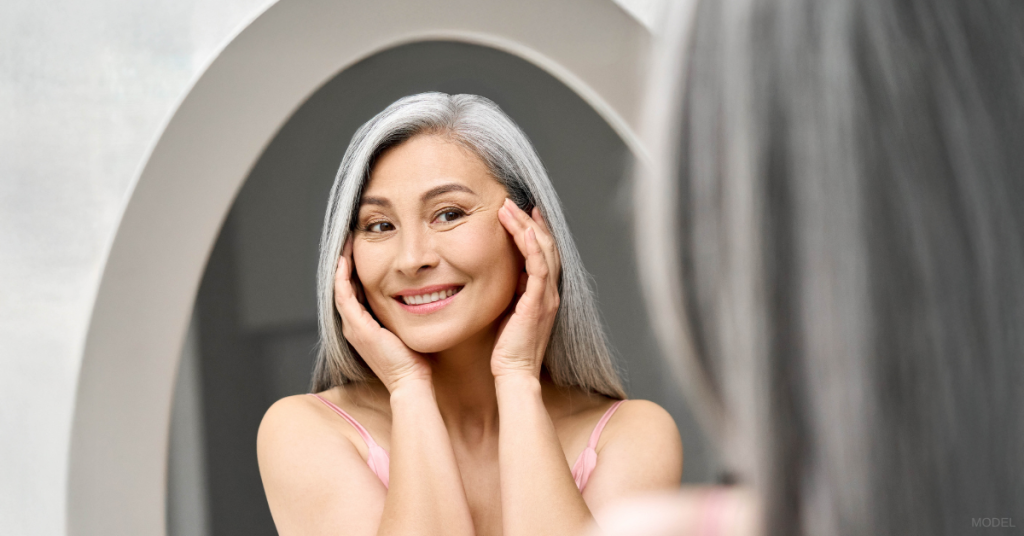
Facial fat grafting at our San Antonio practice is becoming a popular alternative to fillers for patients looking to restore lost facial volume using their own natural tissue vs synthetic materials.
As we age, one of the most significant changes in the face isn’t just wrinkles—it’s volume loss. The cheeks flatten. The temples hollow. The under-eyes look tired. Shadows deepen around the mouth. Even the jawline can soften.
Facial fat grafting allows me to restore that lost volume using your own fat rather than synthetic fillers, although the two approaches also complement each other. If you’re exploring facial rejuvenation options in San Antonio, below I answer the most common questions my patients ask about facial fat grafting.
What Is Facial Fat Grafting?
Facial fat grafting (also called fat transfer to the face) is a procedure in which I gently remove fat from one area of your body (like the abdomen or thighs), purify it, and strategically inject it into areas of the face that have lost volume. Fat grafting can also be performed on other areas of the body to improve contouring.
Fat is typically harvested from areas such as the abdomen or thighs, processed to isolate healthy fat cells, and then strategically placed in the face.
What Are the Benefits of Facial Fat Transfer?
Because I use your own tissue, facial fat grafting offers these unique benefits:
- Feels natural
- Looks natural
- Integrates into the facial structure
- Can last for many years
Unlike fillers, fat grafting focuses on structural rejuvenation—rebuilding the youthful foundation of the face. I often combine fat grafting with facelift and neck lift surgery or eyelid surgery (blepharoplasty) when volume loss and skin laxity are present.
What Are the Goals of Facial Fat Grafting?
The goal of facial fat grafting is to restore youthful contours and facial balance—not to add excessive fullness.
My focus is to:
- Restore natural volume
- Soften shadows
- Improve hollowing
- Enhance facial harmony
- Avoid the “overfilled” look
Fat transfer to the face is about looking refreshed—not altered.
Who’s a Good Candidate for Facial Fat Grafting?
You may be a strong candidate for facial fat grafting in San Antonio if you have facial volume loss and want a natural, long-lasting solution.
Ideal candidates often:
- Notice hollowing in the cheeks or under eyes
- Prefer using their own tissue instead of synthetic fillers
- Are undergoing facelift or eyelid surgery
- Have adequate donor fat
Patients with significant skin laxity may benefit from combining fat grafting with lifting procedures.
What Areas of the Face Can Be Treated With Fat Grafting?
Facial fat grafting restores volume to multiple areas affected by age-related hollowing, including:
- Under eyes (tear troughs)
- Cheeks and midface
- Temples
- Nasolabial folds
- Marionette lines
- Jawline
- Chin
- Lips
- Certain acne scars
In many patients, the midface (cheek area) is the most important region to restore. When the cheeks are supported, the entire face looks refreshed—without looking “filled.”


How Is Fat Harvested for Facial Fat Transfer?
Fat is harvested using gentle, small-volume liposuction techniques designed to preserve fat cell health.
Common donor areas include:
- Abdomen
- Flanks
- Inner thighs
Only a small amount of fat is needed. The incisions are tiny, and most patients notice little change in the donor area beyond subtle contour refinement. Gentle, low-pressure techniques are used to preserve the health of the fat cells.
How Is the Fat Processed Before Injection?
After harvesting, the fat is purified (separated from fluid and oil) so that only healthy fat cells are used.
The fat is then injected in tiny microdroplets throughout the targeted areas. This technique maximizes blood supply and long-term survival. I prioritize precise placement for optimal results.
How Much of the Transferred Fat Survives?
On average, about 50–70% of transferred fat survives long-term.
Facial fat grafting patients can expect:
- Some volume loss during the first 3 to 6 months
- Final results around 3 to 4 months
- Long-lasting volume from fat that successfully integrates
I often slightly overfill areas to account for normal resorption. The fat that survives behaves like “normal” fat and may fluctuate with significant weight changes.
What Is Recovery Like After Facial Fat Grafting?
Most patients experience swelling and bruising for 1 to 3 weeks, with gradual refinement over several months.
Typical recovery includes:
- Swelling: 1–3 weeks (under eye swelling may last longer)
- Bruising: 7–14 days
- Under-eye swelling may last longer
- Return to social activities: 10 to 14 days
When fat grafting is combined with facelift or eyelid surgery, recovery follows the timeline of the primary procedure.
What Are the Risks of Facial Fat Grafting?
Facial fat grafting is generally safe when performed by an experienced, board-certified plastic surgeon, but like any procedure, it carries risks.
Common temporary side effects include:
- Swelling
- Bruising
- Temporary asymmetry
Less common risks include:
- Lumps or irregularities
- Fat resorption
- Infection
- Need for revision
- Rare vascular complications
A deep understanding of facial anatomy and careful technique are essential to minimizing risk.
Should You Choose Fat Grafting vs Dermal Fillers?
Fat grafting, HA-based fillers, and injectables like Sculptra® Aesthetic serve different roles and are often complementary.
Fat grafting:
- Uses your own tissue
- Long-lasting
- Requires downtime
- Structural volume restoration
Dermal fillers:
- Synthetic product
- Temporary (6–18 months)
- Minimal downtime
- Ideal for refinement
Many patients benefit from both—fat grafting for foundational volume and fillers for fine-tuning.
Is Facial Fat Grafting Right for You?
Facial aging is usually caused by a combination of volume loss, skin laxity, and texture changes—a personalized consultation allows us to determine what’s right for you. We’ll explore whether facial fat grafting alone, or in combination with other procedures, will best achieve your goals.
If you’re considering facial rejuvenation, facial fat grafting in San Antonio may offer a natural, long-lasting solution. I invite you to request a consultation with me at Ablavsky Plastic Surgery by completing the online form or calling us at (210) 942-6672.
Leave a Reply